Nursing
The mission of the Purdue University School of Nursing is to serve the citizens of Indiana, the nation and the world. We do this through discovery that expands the realm of nursing knowledge as well as learning by disseminating and preserving knowledge that prepares beginning and advanced nursing graduates for professional licensure and leadership in their work settings. We practice engagement through the application of nursing science from local to global healthcare settings and advocacy through participation in healthcare legislation and policy that respect diverse client populations.



Undergraduate Programs
Purdue’s direct-admit undergraduate nursing program prepares you to excel as a nurse and gain clinical leadership experience. Through cutting-edge curriculum and valuable hands-on learning, you’ll be prepared to work in a variety of healthcare settings, from hospital emergency rooms to rural clinics.
Majors:
- Nursing, Bachelor of Science
- Nursing, 16-Month Second Degree Bachelor of Science (program in no longer actively accepting applications)
Graduate Programs
Accelerate your career with an advanced degree from Purdue’s School of Nursing. Grow your interprofessional knowledge and build skills in leadership, scholarly practice, clinical expertise, health policy and finance, and systematic quality improvement.
Programs:
- MS with Adult Gerontology Primary Care Nurse Practitioner Program
- MS with Family Nurse Practitioner Program
- MS with Primary Care Pediatric Nurse Practitioner Program
- MS with Psychiatric/Mental Health Nurse Practitioner Program
- Doctor of Nursing Practice: BSN-DNP or MSN-DNP
- PhD in Nursing
Post-Master’s Certificate Programs:
- Adult Gerontology Primary Care Nurse Practitioner Certificate
- Family Nurse Practitioner’s Certificate
- Primary Care Pediatric Nurse Practitioner Certificate
- Psychiatric/Mental Health Nurse Practitioner Certificate

School Research
To advance evidence-based care delivery, faculty in the School of Nursing engage in a variety of research, investigating topics such as aging and long-term care, women’s health, community-based interventions, nursing leadership, simulation and pedagogy, substance use, depression and more.
Learn More

Diversity, Equity and Inclusion
The School of Nursing seeks to eliminate systemic racism in healthcare by incorporating diversity, equity and inclusion (DEI) initiatives throughout our learning, research and practice. More than 40 years ago, Clara E. Bell, Purdue’s first Black nursing faculty member, recognized the pervasiveness of systemic racism in healthcare. Today, we acknowledge the work still to be done, and we strive to carry on Dr. Bell’s legacy through our guiding principles.
Learn More
Community Resources
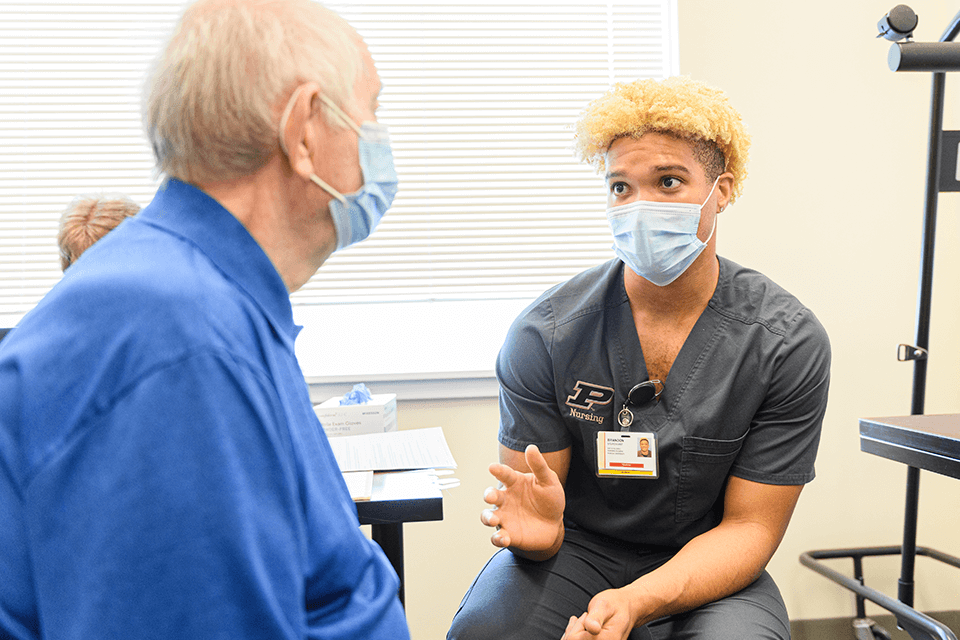
Through the Nursing Center for Family Health, the Family Health Clinic and the Nursing Center for Education and Simulation, we provide valuable clinical experiences for students and important health services for the community.
Learn MOreContact Us
(765) 494-4003
Phone- martinrj@purdue.eduEmail
- View ProfilePersonal Website
Roxanne Martin
Lead Administrative Assistant
(765) 494-4042
Phone- kauffmas@purdue.eduEmail
Susan Kauffman
Undergraduate Program Contact
(765) 494-9248
Phone- jfranklin@purdue.eduEmail
Jenny Franklin
Graduate Program Administration Specialist